We’re used to complaining about our bosses, and how they never seem to get anything right in their decision-making, or how we would do things differently if we were in their shoes. However, are we focusing too close to home?
What if it’s not entirely their fault that they are incompetent? We know about the Peter Principle, and we know from Elliott Jaques and Michael Commons that roles have levels of complexity that the role-bearer must match, or they burn out.
But what if incompetence is like culture in that it comes from the top? After all, a rotting fish rots from the head down. I call this premise: A Cascade of Incompetence!
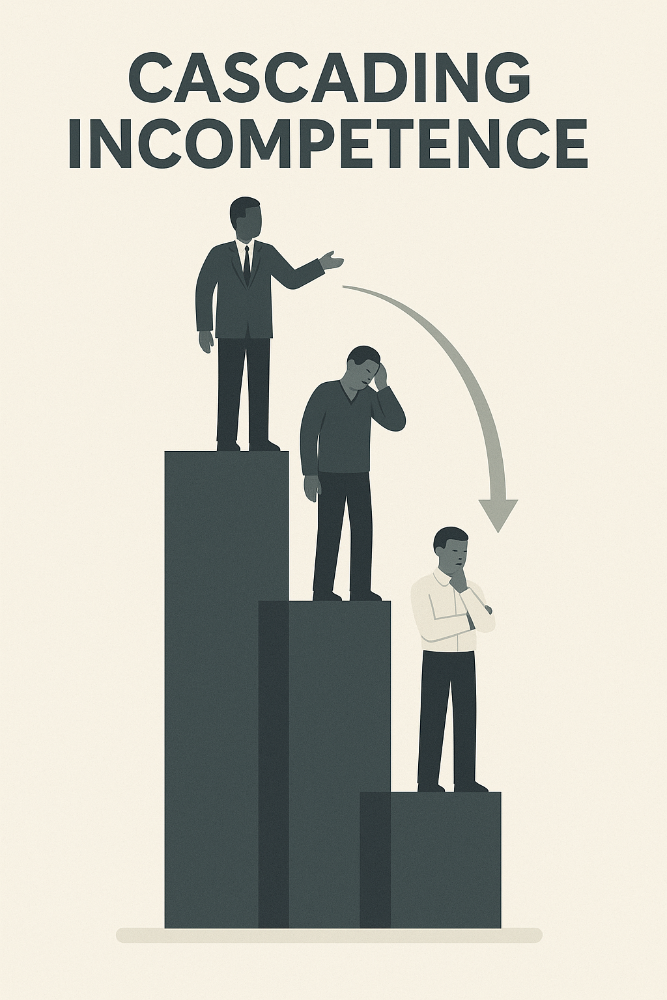
A cascade of incompetence is the downward propagation of inadequate thinking, decision-making, and behaviour throughout an organisation. It implies that incompetence is not isolated to individual roles, but rather systemically reproduced and reinforced from the top down.
Depending on the organisational context, how are we to trust our leaders when incompetence in the ranks leading up to them is ignored?
Key Components of the Cascade
Here is an explanation for the sake of LinkedIn. A fuller version will be in my up-coming book: Leading Deliberately.
Leadership Deficit at the Top (TQ/AQ Misalignment)
Poor leadership decisions, often the result of low complex thinking (TQ) and low self-Awareness (AQ), fail to model critical, deliberate, or self-aware thinking. Leaders may delegate without context, demand compliance without understanding, or mistake authority for intelligence (a trait of AQ4–5 thinking), and a separate article I wrote, called: Authority Superiority Syndrome. This sets a normative benchmark of unreflective behaviour from the top.
Cultural Imitation and Cognitive Limitation
Middle managers then emulate the thinking patterns of those above them, not because they work, but because they appear rewarded. This would be a Level 3 issue, Socialised Mind. The middle manager is effectively saying: look at me, I’m just like you.
Over time, this normalises cognitive shortcuts, groupthink, and low-complexity responses to high-complexity problems. Thinking becomes procedural, reactive, and defensive, further embedding incompetence, especially when questioned by a subordinate who might see through the patterns.
Disempowerment of Competence
High-AQ individuals are often marginalised, dismissed as a trouble-maker, or pressured to conform. Systems punish dissent, reinforcing a culture of compliance over cognitive autonomy. The cascade thus selects for conformity over competence, further fuelling its own momentum. Anyone with a self-authored perspective is labelled as “difficult”. Steve Jobs once said that he doesn’t understand businesses that hire intelligent people and then tells them what to do.
Perpetuation Through Systems and Structure
Performance reviews, promotion criteria, and hiring practices become based on alignment rather than awareness. This is a faux-culture argument that only serves to perpetuate the socialised nature of the hirer’s thinking. Metrics measure output, not quality of thinking, ensuring that poor systems remain intact. We might call this “Group Think” if we thought about it, and it creates a feedback loop, where incompetence becomes institutionalised.
What happens when the incompetence cascades, as per the image above? We get rewarded with leaders who avoid complexity, decision-making without reflective pause, or insufficient self-awareness and thus complexity to ensure the reflection is joining the right dots.
We become over-reliant on rigid processes, thinking they will proxy for good decisions. Staff become fearful of speaking truth to power. Especially those who know the powers won’t understand it. And finally, repeated mistakes explained away rather than explored. If you work in an organisation where: “We’ve always done it this way” is common, please reconsider your personal growth and find a more developmental environment.
The CDT Response: Interrupting the Cascade
What is the answer to all this lack of complex thinking in positions of power? I’m not saying this is the only way, but it’s one way. Using Constructed Development Theory, we can:
- Diagnose where low-AQ thinking is embedded within layers of the organisation.
- Raise awareness by mapping Thinking Styles across the leadership hierarchy.
- Introduce Deliberate Disequilibrium, challenging the comfortable incompetence through cognitive interventions.
- Develop internal AQ so leaders begin to recognise the impact of their construction on others.
I would do this using the Three Leaders programme. A cascade of incompetence isn’t merely about individual failure: it’s about the unconscious replication of poor thinking habits [lack of awareness] through organisational layers.
Unless awareness is constructed at the top and diffused with Intention and Awareness, incompetence becomes the culture, not the exception.
Let us finish with a few bullets for clarification, and a new image:
- The leader at the top is not malicious — just unaware.
- Each level below amplifies distortion.
- By the time it reaches the bottom, it looks like “individual incompetence”, but it’s structurally constructed.
- The cascade is systemic, not personal.
That fits beautifully with how I destabilise surface-level blame and redirect attention to awareness structures. But more on that in my Leading Deliberately book!