Authority Superiority Syndrome (ASS)
The Experience and The Issue
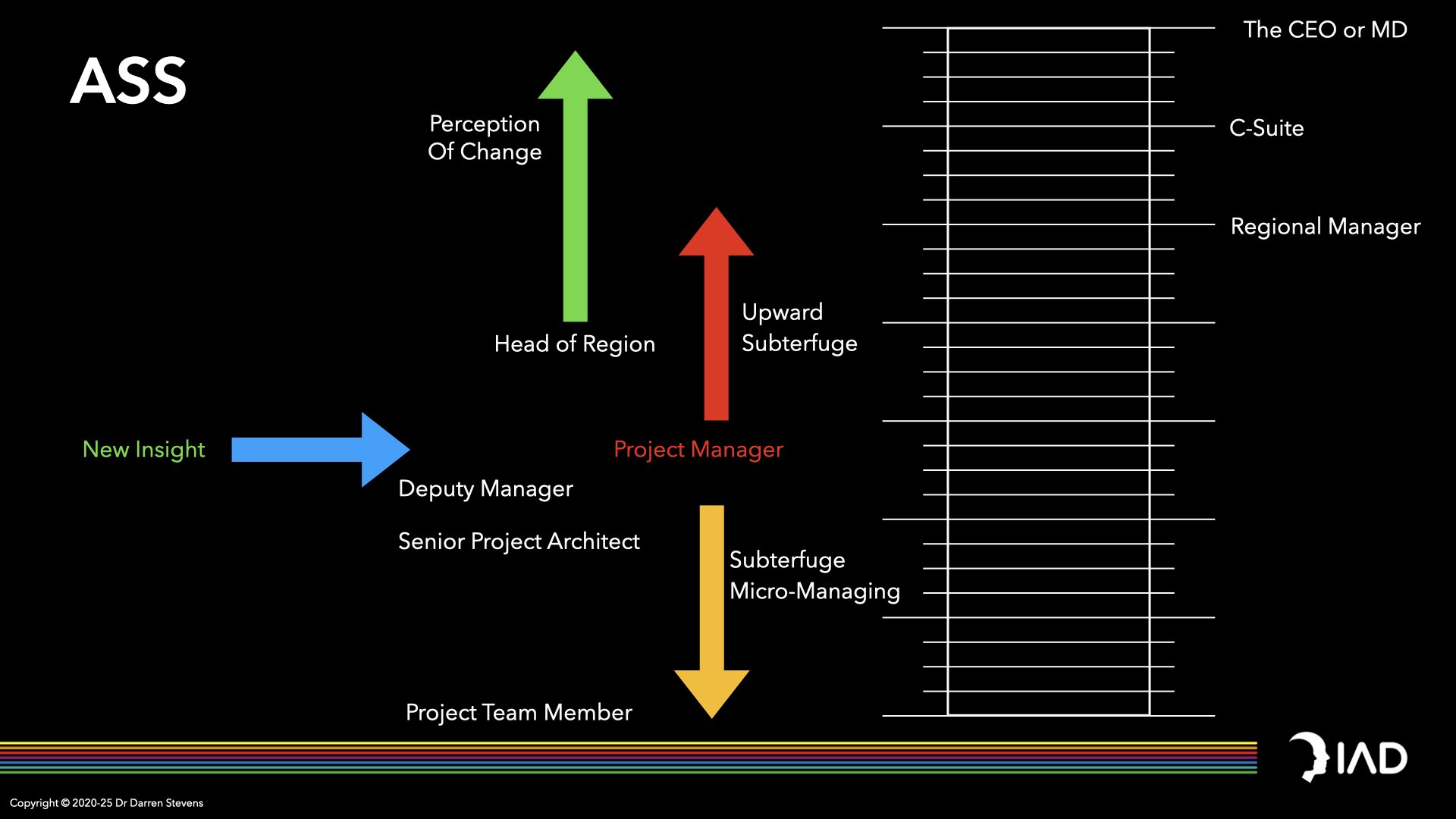
What I see every day is the use of rank as a benchmark for one's perception of intelligence. It doesn't matter which organisation we are working in, or which industry, the general perpcetion is this: an edict comes down from on high. You, as the protagonist are instructed to implement said plans until management is happy their instructions have been followed.
But note that they're not asking for feedback. When presented with arguments that counter their previous commands, and an explanation as to why this particular command is not feasible given the wider picture (Global) or preivous instructions (Procedural), it is at this point that they pull rank and say: Just get it done.
Zero effort on their part. Zero thinking taking place. Zero dots being joined.
An Example
You would expect academia to be filled with erudite people, with at least a rudimentory grasp of complex thinking. You would expect.
However, this is seldom the case. In my experience of 3 universities, this is actually far from the case.
In my case, we as a faculty were asked to introduce a number of Apprenticeships in order to increase apprentice numbers as the government and business fund these types of degrees. It's a no-brainer from an income perspective. And as I was already running the only business Apprenticeship in the univeristy, I was asked to help the new ones come into existence. I wasn't running mine very well, to be honest, but that's a story for a different page.
The idea was that at level 4 (1st year) we could overlap some of the modules and thus save money on teaching and resources, etc. One module on the business Apprenticeship for marketing could also be taught on the Marketing Apprenticeship, at the same time by the same lecturer. It makes sense.
However, the university has a change process one must adhere to in order to improve their degree programmes. This is where the fun begins and the thinking ends.
It was highlighted by me that there is no point doing a change of approval request until all the new Apprenticeship leads have had a chance to discuss and determine which modules they think are the most appropriate for their level 4 Apprentices, and which of those overlap with the existing programme (mine).
I was told to just get on with it. I didn't get on with it. I waited until they appointed a new role, called the Apprenticeship Lead.
What is the actual issue?

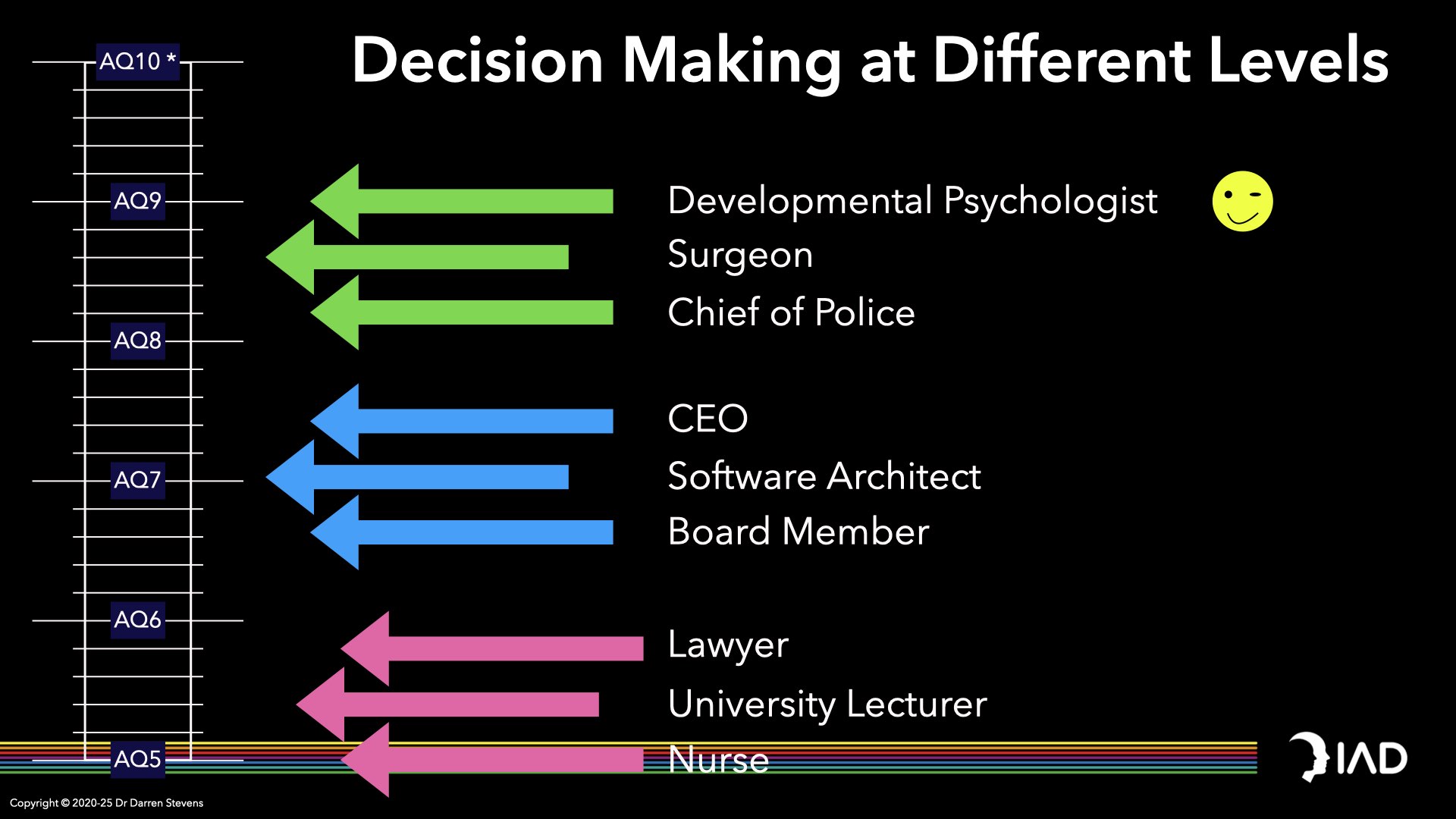
The actual issue is that the person in the role who is making the orders assumes that by virtue of her rank, she is more capable than me at thinking of the outcome needed. This is simply because she thinks she is privy to more business-specific information to which I am not. Which is true. This suggests to her that her decisions are higher level, when in reality, they are simply less complex given the rank she occupies.
A more complex decision would include the facets of her role, the information coming in, and the dots joined that I am capable of joining lower down the ladder, as well as the informational dots I am not privy to.
However, this is seldom the case. Instead of joining every dot available to me, she ignores those dots that are difficult to map out, such as Global and Abstract, and instead barks her orders to "just get on with it".
She essentially used her rank to force an outcome that is ill-thought out. But who will pay the price when it all goes pear-shaped? Not her. That is not the nature of Academia, where a blame culture is rife.
When it comes to the intersection of change and leadership, the opportunity and the problem boil down to complexity. As a leader rises in the ranks, her responsibilities and the complexity of her job rise together. In the chart below, the red represents what the leader brings to the table to meet the demands of each career level. Green represents the level of complexity at each level.
The leader’s ability to handle complexity can’t keep pace with actual complexity, making it increasingly difficult to meet expectations as responsibilities magnify. Leaders, meet the complexity gap.
Core Components:
Role-Dependent Self-Worth:
The individual ties their self-esteem directly to their position, authority, or credentials rather than actual skill or knowledge.
Misattribution of Expertise:
They overgeneralise their competence, believing that their expertise in one area extends to others without sufficient evidence.
Confirmation Bias:
They selectively interpret feedback or experiences that affirm their belief in their intellectual superiority while ignoring contradictory evidence.
Overconfidence Effect:
Cognitive bias leads them to overestimate their abilities, especially in unfamiliar or unrelated fields.
Social Reinforcement:
Being treated with deference or receiving praise for their role feeds into their inflated self-perception.
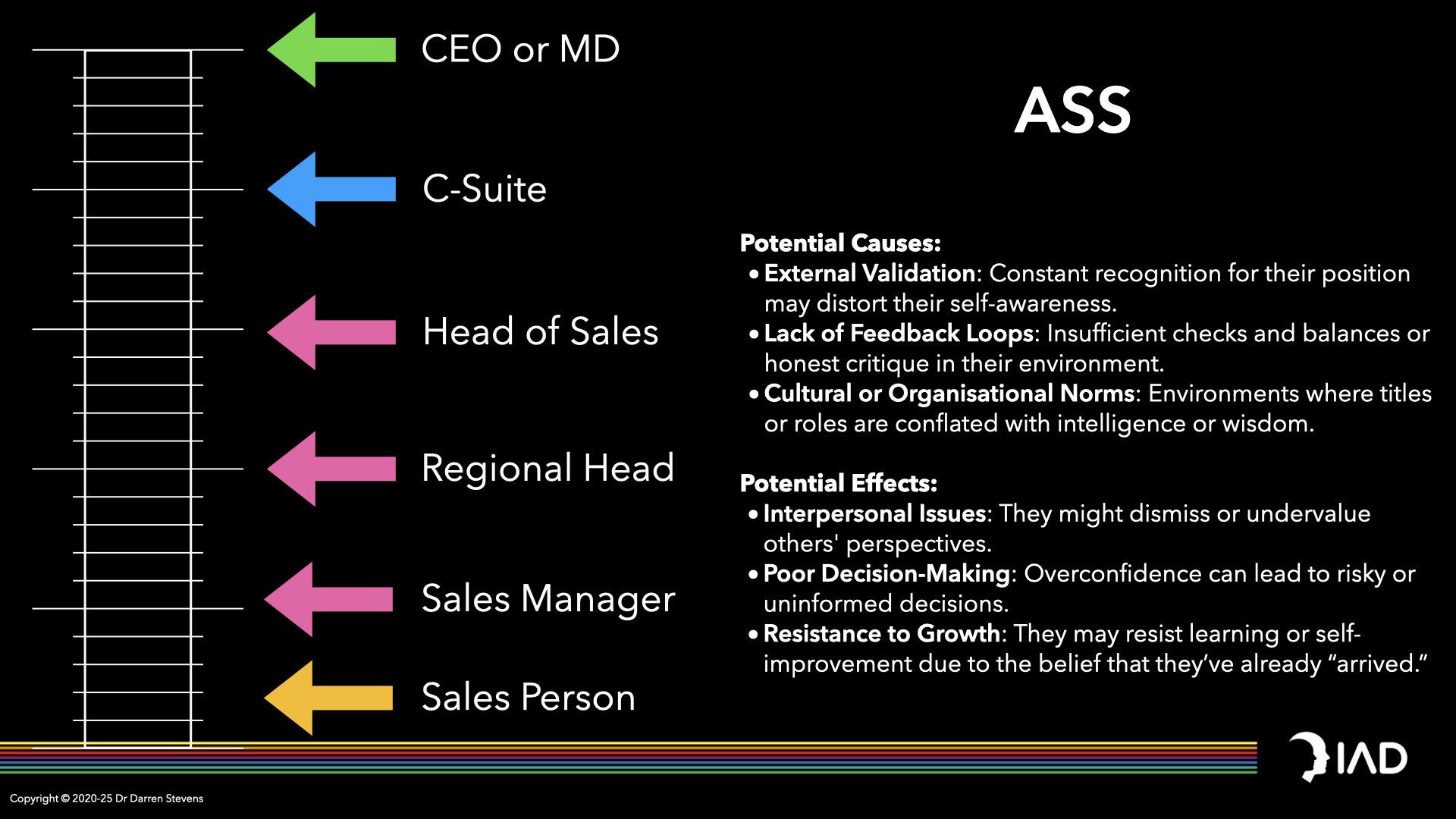
Potential Causes:
External Validation: Constant recognition for their position may distort their self-awareness.Lack of Feedback Loops: Insufficient checks and balances or honest critique in their environment.
Cultural or Organisational Norms: Environments where titles or roles are conflated with intelligence or wisdom.
Potential Effects:
Interpersonal Issues: They might dismiss or undervalue others' perspectives.Poor Decision-Making: Overconfidence can lead to risky or uninformed decisions.
Resistance to Growth: They may resist learning or self-improvement due to the belief that they’ve already “arrived.”
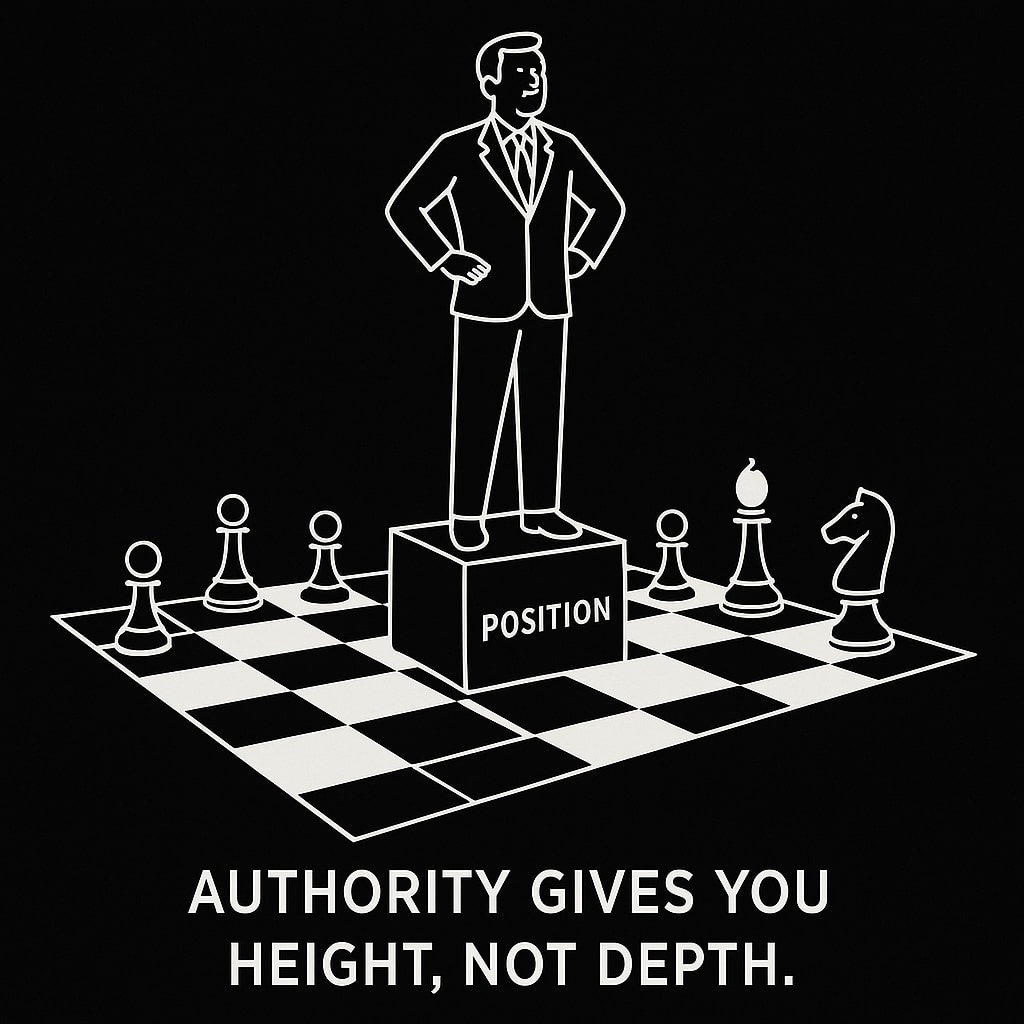
At the end of the game, both the king and the pawn go back in the same box!
No matter how much “positional superiority” someone assumes on the board, the ontological equality remains: king, pawn, or bishop, all are constructed functions within context, and when the game ends (or awareness dissolves the illusion of separation), they all return to the same box.
Check out the images below. I have used a non-descript organisational context here, however, these principles obviously transcend all contexts.